
Case 4 - Class 1: Severe upper, mild lower crowding, buccally displaced upper canines. Fixed Appliance Plan: Upper extractions ± TPA nance
In this case walkthrough, you will see two step-by-step fixed appliance treatment plans that would produce a beautiful result. The first plan is the easiest as it involves removing the buccally displaced upper canines. The second plan is trickier to get right as it involves aligning those displaced upper canines after extracting the first premolars. In the video, I'll spell out exactly how I'd make each plan work predictably and below I've summarised it for a quick refresh.
CASE SUMMARY
Diagnosis / Problems List
-
High smile line
-
Incisor Class 1 (? Class 2 (2))
-
Mild lower crowding
-
Slightly increased overbite (Lower 2s)
-
Buccal segments Class 2
-
Upright / retroclined incisors
-
Slightly increased COS
-
Severe upper crowding
-
Buccal displaced Upper 3s
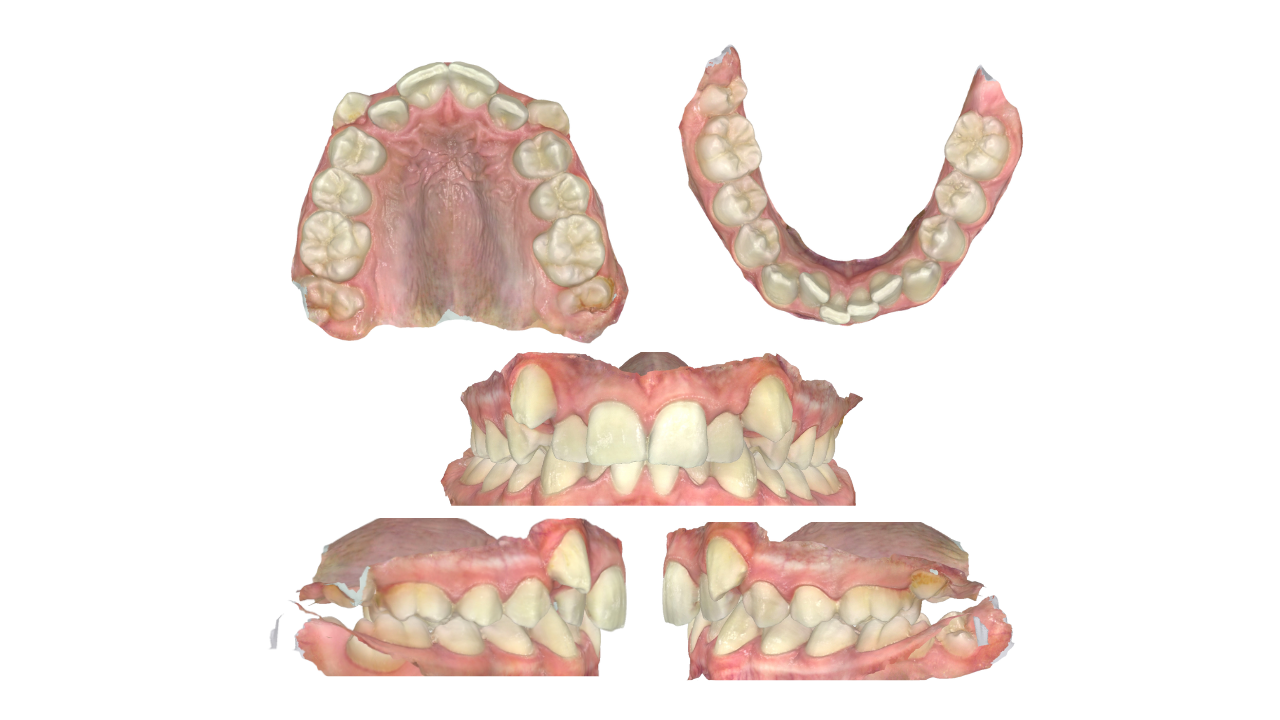
Mechanics + Appliances
- Upper and lower fixed appliances
- Class 1 incisor mechanics
- Some deep overbite mechanics
- High anchorage mechanics
- Class 2 canine mechanics
Treatment Plan Summary - Plan 1
- Extract upper canines
- Upper and lower fixed appliance
- Re-assess for lower interproximal reduction (IPR) / extraction (XLA) - very unlikely
- Retain
Treatment Plan Summary - Plan 2
- Transpalatal arch with a nance button (TPA nance)
- Extract upper first premolars
- Upper and lower fixed appliance
- Re-assess for lower interproximal reduction (IPR) / extraction (XLA) - very unlikely
- Retain
Archwire Sequence - Plan 1
- 014N / 014N
- 18x25N /18x25N
- Powerchain U2-2
- 19x25S /19x25S
- Powerchain U+L 6-6
- C2 elastics if required
- Anterior cross elastic if required
- 018S / 018S
- Powerchain U+L 6-6
- Zigzag settling elastics
- Anterior cross elastic if required
- Debond + Retain
Archwire Sequence - Plan 2
- TPA nance
- 014N / 014N
- 18x25N /18x25N
- Powerchain U2-2
- 19x25S /19x25S
- Powerchain U6s-3s, U2-2, L3-3
- C2 elastics if required
- Anterior cross elastic if required
- Remove TPA nance
- 19x25S /19x25S
- Powerchain U+L 6-6
- C2 elastics if required
- Anterior cross elastic if required
- 018S / 018S
- Powerchain U+L 6-6
- Zigzag settling elastics
- Anterior cross elastic if required
- Debond + Retain
Dr Ib Rominiyi | Orthodontic Specialist & Mentor
Explore all cases in the Ortho Playbook Library
Welcome back to the ortho playbook. Let's get into this case. So this case is a class one case with severe upper and mild lower crowding, and the upper threes are buccally displaced. I'm gonna go through two different plans with you. Okay? So this patient really didn't like the fact that their fang teeth, which is their canines, are sticking out. Didn't like this here. They're fourteen years old, fitting well, no trauma or habits. Extraorally, they were class one. Everything was average, but they did have a high smile line. Intraorally, they clearly need to improve their oral hygiene, especially on these upper canines, which are commonly missed. And they had upper seven to seven present, but the seven's partially erupted with severe crowding. You really don't have enough space for these canines. It's definitely more than eight millimeters. And in the lower arch, they had lower right seven to the lower left six. That seven's only just about starting to erupt. That was more mild crowding, on the top end of mild I would say, but still mild. The incisor classifications class one question mark class two div two, sometimes it's hard to really see where those lower incisors are sitting compared to that cingulum plateau but very close. The overjet was average and the overbite was slightly increased especially on these lower lateral incisors mainly because they are displaced lingually whereas the central incisors were fine. The upper centre line was correct and so was the lower. The canine relationship on the right hand side, this is basically a full class two, and the molars on the right are also a full class two. And then on the left, the canine is again a full class two and so is the molar. So we've got four class two buccal segments. Crossbites. There were no crossbites in this case, and so there were no displacements. And the incisors, the uppers were quite upright relative to the maxillary plane, and the lowers were retroclined relative to their mandibular plane. So that does that's why it makes it suggest it's a little bit more of a class two div two as well, but very close. And there was a slightly increased curve of speck on in this case, just slightly more than average. And the main other feature is just that these upper threes are buccally excluded. There's almost a two four contact point, so it is quite severe crowding in this upper arch. So the OPT here shows that they've got, yeah, all the teeth present apart from this upper left eight and the lower left eight. I think that's a seven that's developing here. And the problem list for this patient is a high smile line. The incisor relationship was class one, maybe class two to two, severe upper crowding, mild lower crowding, slightly increased overbite on affecting the lower lateral incisors. Buccal segments are a class two, left and right, and the incisors are upright or retroclined. A slightly increased curve of spay and buccally displaced upper threes. So that is her orthodontic diagnosis. OPT shows no pathology, normal bone levels, and root lens. So these are the treatment aims, my standard template for an ideal occlusion. And so to personalize it for this case, she needs to achieve excellent oral hygiene. We need to relieve the crowding. I aim to level and align the arches. That's just getting all the contact points lined up. I'm aiming for class one incisors. I wanna achieve class one incisors, and I wanna maintain a full unit molar relationship. So I wanna maintain class two. I can't have it any less than that. And I want to achieve or maintain class one incisors with an average overjet and an average inclination. So I wanna correct the inclinations on these. I want to maintain my coincident centerlines by matching centerlines and maintain my coordinated arches so that there's no crossbites. I wanna make sure there's no residual spacing and I wanna finish in detail and then retain all of my changes. So next is the gearbox. So this is the simple hack that I use. It's a simple framework that I use to hack orthodontic decision making. And it's the questions that I ask to find the mechanics that I need to build a plan that I can trust. So let's get into it. So in terms of crowding, I believe that we're gonna need extractions to relieve this crowding. Now I know there's some people who would try and just align this and proclaim it all further forwards. And if you're looking from the occlusal view, it looks like, okay, you get your canines here. You just need to get these incisors in here. That's not too much space. But remember, your canines are buccally excluded. They are not in the line of the arch. So you're really trying to get your canines into this tiny space. And once this incisor is lined up, you really have a millimeter and a half to play with here, maybe up to two, more like one and a half to two millimeters here to try and line these up. Your canines are normally about eight to nine millimeters wide. That's just a big ask. So I would say that this is severe crowding, and I would extract personally in this case. In the lower arch, however, this is more mild, and so I would try and manage this non extraction and maybe some IPR. I think you might most likely would need that and just reassess for extraction. And if I did need to take anything out, it would just be one of these small little incisors, one of the ones I would take out, and I would like to avoid it. The main thing that I'll be looking for is if there's any recession. If we develop any recession, then I'm more inclined to extract an incisor than, IPR, depending on the extent of the recession. Okay. So that's crowding. Now level and alignment, I'm gonna use my standard aligning arch wires, and I would use lace backs in all quadrants. Okay? I've got to say in terms of the extraction for the crowding if I'm extracting, I would either extract the upper threes or the upper fours. Now normally, I like to keep the canines. They're the strongest tooth with really long roots. And so you use them when you're sliding from side to side. So your lateral excursions, that's why they've got a long route to take all of that force. Ideally I would take out the fours and retract the canines into the correct position, get them back into class one. Alternatively, as the fours are already in the position of the canines and they make a very reasonable alternative, I could just extract the threes and then this becomes a very, very simple case. If you're gonna have the fours in the position of a three, there's lots of little things that you can do to try and mask that. But the main thing is you kinda wanna go for group function. So you're not trying to get canine guidance where you slide from side to side just on these fours. When they slide from side to side, you wanna be sliding on all of the teeth or multiple teeth. Those are the main things. So, yeah, that that's the extraction pattern for those. Okay. So in terms of the just going back to the lace backs. If I was gonna manage with lace backs, I would have it in the lower arch definitely because I wanna hold these canines back. We know that the canines, when you bond them up, they're gonna come forwards because the canines have the greatest amount of mesial tip. They tip forwards. And then that's just gonna encroach in this space, which is already crowded. So I kinda wanna keep them where they are with my lace backs, fix this distance, give the incisors some breathing room so that they can line up, and then let go of the lace backs and let the canines go to their normal position. And then in the upper arch, I'll do the same. I'd have if I'm taking out the four, I'll lace back to the canine to bring it back down. If I'm taking out the threes, though, then I wouldn't need lace backs in the upper arch because there's enough space for these incisors to line up, so that's fine. Okay. So now for the overbite. And as we've got an increased overbite, especially on those lateral incisors, I would consider deep bite mechanics and probably a combination of some of these. So I'll just put plus or minus for a flat anterior bite play, and I don't really think we would need it in this case, but we would see, because there's some of the other options that aren't available to me. So I would have preferred to just bond the lower sevens, but we don't really have any on that side, and this one's partially worked in, not enough to put a proper bracket on it. So we would have to just limit it up to the sixes. I would definitely work up to a rectangular arch wire, a nineteen twenty five stainless steel arch wire, to help flatten this occlusal plane. I would sweep a reverse curve of spay in that arch wire, and that's gonna help flatten the occlusal plane. And I would do some class two elastics as well. And that's gonna help extrude the molars and flatten the occlusal plane. So a combination of them should be sufficient, I would feel, but I would reassess it. If I needed a flat anterior bite plane, I would do it. And then canines. How am I gonna get my canines to class one? So depending on the extraction pattern, assuming we're taking out the upper fours, if I'm getting the canine to class one, then I'm gonna use a combination of different things. So we are gonna extract, so it's either the upper fours or the upper threes. I would do lace backs from my upper six to the upper threes to retract this canine back down when I'm in my night high arch wires. And then I would move that up to power chain from upper six to upper three to retract the canines back when I get to my stainless steel arch wires. And, obviously, I would use my class two elastic, which is gonna bring these canine back into class two. And I'd always ask the patient to stop the class two elastics if they're biting edge to edge. Now if I'm extracting the upper threes, then the upper four, which is acting as my canine, is already class one. So we don't need to do anything, and that'll be fine. And then my molars, I wanna maintain a full unit, so that's class two. And this, again, depends on the extraction pattern. If I'm extracting the upper threes, the molars are a class two. I'm not gonna expect much change when we just close this little bit of space here. That will be fine. But if I do extract the upper four and I'm retracting the upper k and I am back to class one, I know that I'm gonna need to reinforce that anchorage because the molar's already a class two. As we retract this canine back, the canine's got a big root. It doesn't wanna move. The power chain or whatever force you use is gonna wanna pull this molar forwards into that space. I wanna hold it, make sure it doesn't move. So you can use your tad. You can use headgear. I personally would use a tPA nant if I've extracted these upper force. And then incisors. How am I gonna achieve class one incisor relationship? Now I'd expect a class one finish regardless of which teeth we extracted, so I'd use my class one incisor mechanics, and I'd work to upper and lower nineteen twenty five stainless steel large wires. I'll do power chain sixty six to retract these incisors back, and I would do class two elastics to, again, retract these incisors back. In terms of the centerline, I would just do my normal standard elastics or IPR if needed, but hopefully we just maintain the same matching centerlines. And for the cross buy, I would expect that to remain the same, and so I just keep that under review as well. Finishing will be my standard finishing on upper and lower o one eight stainless steel arch wires, do any repositioning or finishing bends as required, power chain sixty six if there's any space. With my settling zig zag elastics and an anterior cross elastic if needed. And then I would debond and retain with normal vacuum formed retainers plus or minus bonded if they had good oral hygiene. So your treatment options standard. Number one, leave and monitor. Number two is to extract the upper threes and open their fixed appliances and reassess for lower IPR or extraction of one of that little incisors. I would and then retain. I would use deep bite mechanics and or some of my deep bite mechanics, and I would use my class two elastics, and that's gonna be my standard ones, expecting a standard finish. Option number three is a TPA NANS and extracting the upper fours. Upper and lower fixed appliances, reassess again for lower IPR extraction and retain. So it's again the same deep bite mechanics, the same class two mechanics, but I would add maximum anchorage mechanics as well to make sure this molar doesn't move forward after the premolar extraction. So let's look at option one step by step. If we're extraction or the plan with extraction of upper threes. We take out the upper threes, and then I'll bond all the teeth up and lower. And I'll include the lower sevens if they do erupt by the time we get to bond up. And I would have lace backs in this case just in the lower. I wouldn't need it in the upper because my fours are in my new canines, and I've got more than enough space for these incisors to line up so I don't need to do any lace backs in the upper. I would do my posterior bite blocks or little blobs on the upper sixes to pop open the bite if patient is biting on the teeth, or bite raising modules or a flat anterior bite plane. I personally would probably just do the posterior bite blocks with bite raising modules with the little cushions on these lower lateral incisors. I think that should be sufficient. And then I'd retie until it's passive. Again, you could do an o one o one six night high as an intermediary wire. I don't think I would need to. I would probably just jump straight to my upper eighteen twenty five nighttime with power chain upper two to two if there's any space and a lower eighteen twenty five nighttime, I should say there. And then the next visit, I would work up to nineteen twenty five steels in the upper and lower. The objective now is to correct the overbite and the incisors to class one. And because my canines are basically, which are my fours, are basically already class one. So I would do all of the mechanics on my working arch wire. So my reverse cove of spay, I would sweep that into this nineteen twenty five steel in the lower to help correct the overbite. I would do power chain six to six to just close the spaces and retract these incisors back to class one. I will consider some class two elastics for the overjet from the lower sixes to the upper. You can go to the upper twos or to the upper fours. It doesn't really matter. And get them wearing that all the time, but to stop if the patient's biting edge to edge. That means the overjet's overcorrected. We have an anterior cross elastic for the centerline if required, and just reassess for IPR or extraction in the lower. And then once that's all the spaces are closed, I'm just finishing and detailing. So upper and lower o one eight stainless steel arch wires. Any finishing bends or repositioning is required. Power chain six to six and settling zigzag elastics is required to get a really good finish plus or minus your anterior cross elastic if you needed it. And then just debond. So if you extract the upper threes, this is a very, very simple case. All you're doing is getting a teeth straight and closing the gaps. That's it. And you're just trying to get the bite as nice as possible, but we're pretty much there. You can see you've already got quite a nice zigzag pattern. Both sides is just sorting out the alignment and the incisors really. It's a really straightforward case, which looks initially complicated if you just take out the threes. So let's look at taking out the fours. Now this is ideally, as an orthodontist, this is what I would personally go for. I think keeping the canines is ideal. But I would only do this if the patient's got very good oral hygiene. If the oral hygiene is poor and we bring them back for oral hygiene instructions and we're supporting them with them, they get just about okay, then I'll be more inclined to take out the threes because it's just a faster treatment plan. It's gonna be over faster, so it means that the risks of having fixed appliances are reduced, and the risks are greater if the oral hygiene isn't excellent. If they've got excellent oral hygiene, then this is the one that I would go for, but it's the patient's choice. So I would start off with a tPA nant. So that's with molar bands on the six ears, thick wire, and a palatal acrylic button on the palette, which acts to reinforce the anchorage and stops these molars drifting forwards. And then I would extract the upper fours. I would start off with upper and lower o one four night eyes, and I'll bond all the teeth and pick up the lower sevens when they erupt. For this case, I would have lace backs in all quadrants. So in the lower arch, because I've got anterior crowding, I wanna hold these canines back, give these some breathing room. And in the upper arch, it's the same to let these incisors line up and to retract these canines back as well, the lace backs will help with that. And I'd retie until it is passive. Again, you can do an intermediary wire. I don't think you need to. I would just go straight to upper and lower eighteen twenty five night eyes, and I'll do power chain upper two to two if there's any space. And then I would work up to my working arch wires, will be upper and lower nineteen twenty five steels. And the same mechanics as before, so a reverse curve of spay in the lower arch supplying the occlusal plane. But for this one, I would have an intermediary step. So I would do power chain up a six to three to retract these canines back to class one. You wanna bring them back to class one. I don't wanna do power chain up a six to six because that is just going to it's not gonna have the best anchorage balance. I want this tooth with a long root, the canine that doesn't want to move, I'm gonna pitch this canine against the five and the six and the nantes. So if you're comparing those those teeth, the canine's gonna move more, and the the molar isn't gonna move. So that's what I wanna do. I don't want this molar to move as opposed to doing power chain six to six. And now you've got upper three to three, the three to two, and the one all trying to come backwards, and you're really just hoping the six doesn't move forward. It's most likely to move forwards. So I hold the six where it is. We trap the canine back, and then, with the power chain, six to six six to three. In the lower arch, I'll do power chain three to three if there's any space as well. So getting the canine, upper canines back, lower canines forwards to get class one canines just as standard. And I'll do class two elastic from the upper canines down to the lower molars again. This is gonna help reinforce the anchorage, bring this canine back to class one. Always telling the patient to stop if they're biting edge to edge and just reassessing for lower IPR and extraction. And just keep repeating these mechanics until the canines are class one and the overbite is corrected. And then I'm gonna when the canines are class one, overbite is corrected, I'm gonna remove the tPA nant, and I do this before retracting the incisors. If you have a tPA nance here and you retract your incisors into the tPA nance, there is a risk that you can, devitalize your incisors. It doesn't always happen, but that risk is not worth it for me. So I will take off my PA nans before retracting my incisors. And then I would just with the same nineteen twenty five stainless steel arch wires, I would do power chain upper and lower sixty six. So compared to the other plan, you've got this intermediary step to get the canine to class one, and then you do the power chain sixty six to retract the incisors and close that spaces. Add your class two elastics. Again, that can go to the lateral incisors or to your canines. It doesn't really matter. And always tell the patient to stop biting if to stop the elastics if they're biting edge to edge. And you can add an anterior cross elastic for the centerline if you need to. And then standard finishing, up and lower o one eight stainless steel arch wires, finishing bends or repositioning as required, power chain six to six, and settling zigzag elastic just to get a really, really good finish, plus or minus your anterior cross elastic. And then debond and retain. That's how I would manage this case. Speaker 1: ... Speaker 2: ...Click to read the full transcript